
Selling your gold in Singapore: testing, pricing and getting paid
Selling gold back is less complicated than most people expect, but it helps to know what happens at the counter before you walk in. We buy gold and silver back at our shop in Centrium Square on Serangoon Road. The final amount is set after we test your pieces, at the price of that moment. Here is how the testing works, how the price is worked out, why our buying and selling prices differ, and what to bring.
- •We buy gold and silver back after testing each piece at the counter with PMV and XRF, plus Veriscan on PAMP bars.
- •Your price comes from the live world spot price at the moment you sell, based on the pure metal content.
- •Our buying price sits below our selling price, and the gap depends on the product and its condition.
- •Bring your NRIC or passport, any receipts, cards and packaging, and your bank details.
How selling gold to us works, step by step
There's no need to book. Walk in during opening hours, Monday to Saturday 12pm to 8pm and Sunday 2pm to 8pm, and tell us what you'd like to sell. If you want a rough idea first, look at the live prices on our market page, or send us photos of your pieces on WhatsApp and we'll tell you what we'll need to see.
At the counter, the order is the same every time. Nothing is final until you say yes.
- You hand over your bars or coins, with any certificates, cards or receipts.
- We look over each piece, weigh it and test it.
- We quote a price from the live market at that moment, based on weight and purity.
- You accept or decline. If you decline, your pieces come straight back to you.
- If you accept, we record the sale and pay you.
What we check when you bring gold to the counter
We test every piece before we buy it, just as we test everything before we sell it. Staff start with what the eye can tell: the refiner's mark, the stated weight and fineness, the edges and finish, and whether the size looks right for the weight. Then each piece goes on the scale.
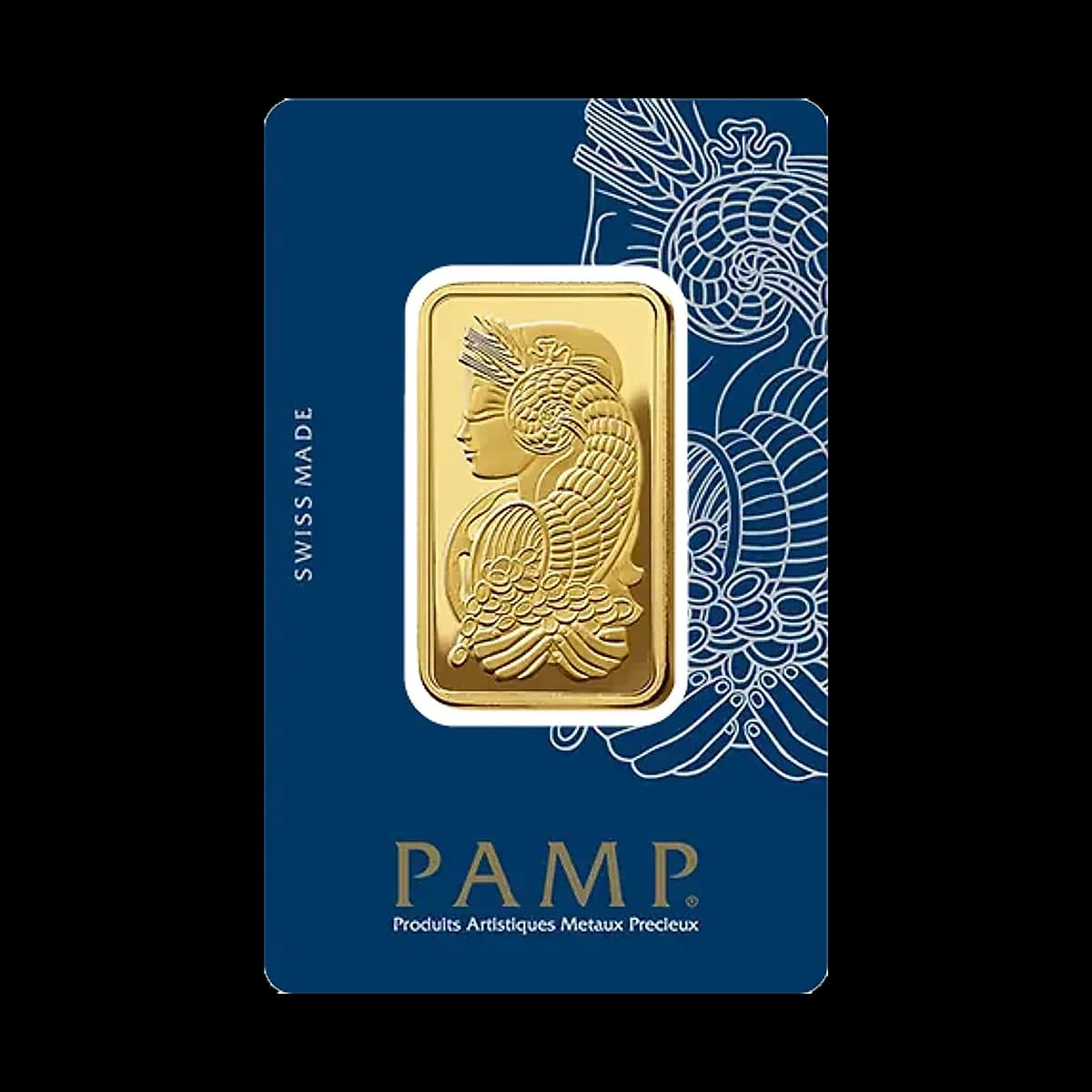
Next come the instruments. A Precious Metal Verifier (PMV) checks how the metal responds electrically beneath the surface, while XRF reads the make-up of the surface itself. PAMP bars also get a Veriscan check, which compares the bar's surface pattern with the one PAMP recorded when the bar was made. Our separate guides on PMV, XRF and Veriscan go into what each one can and can't tell you.
None of these tests marks or damages a genuine bar or coin. If something doesn't add up, we'll tell you plainly what we found and why we can't buy it. It doesn't happen often.
How your selling price is set from the live spot price
Gold trades around the world through the day, and the world spot price moves with it. Our prices follow that live price. The figure you're quoted reflects the market while you're standing at the counter, not what you saw that morning and not what you paid when you bought.
The quote starts from the pure gold in your piece. One troy ounce is 31.1035 grams, and a 1 kg bar holds about 32.15 troy ounces. A 22 karat coin such as a Krugerrand or an American Gold Eagle is 91.6% gold, but the coin is made heavier so that it still holds a full troy ounce of pure gold. So a Krugerrand and a 999.9 Maple Leaf carry the same amount of gold, even though their purity is different.
Because the price keeps moving, we can't fix a number over the phone and hold it until you arrive. You can follow the live figures on bullionking.sg/market so you know roughly where things stand before you come in.
The buy-back spread: why selling price and buying price differ
At any given moment, the price we pay for a bar is lower than the price we sell that same bar for. That gap is the buy-back spread. It isn't a charge for selling. It covers testing, handling, holding stock and getting the metal back into the market.
The spread isn't the same for every item. A well-known bar from a refiner such as PAMP, Valcambi or Perth Mint, in good condition, is easy for us to resell. Unusual items, damaged pieces, or anything that may have to go back to a refinery take more work, and the price reflects that. Our guide on spot price and selling price covers the buying side.
The spread also explains why buying and then selling again soon after usually returns less than you paid. Better to know that going in than to find out at the counter.
What to bring when you sell gold
Bring your NRIC or passport. We're registered with the Ministry of Law under the PSPM Act (registration No. PS20260001016), and we keep records of what we deal in. For larger transactions, above S$20,000, the Act requires us to take your identity details, so carrying your ID saves a second trip.
Paperwork helps as well. Original receipts or invoices, the assay card or certificate, and the original box or pouch don't change how much gold is in a piece. They do make it quicker to confirm what it is and where it came from. If your bar has been taken out of its card, that's fine; it gets tested the same way. Our guide on sealed assay cards explains the trade-offs of opening one.
Please don't clean anything before you come. Polishing, rubbing at tarnish or scrubbing with household products leaves fine scratches, and in our humid weather silver especially will tone again anyway. Bring your pieces as they are, ideally in whatever you stored them in.
- NRIC or passport
- Original receipts or invoices, if you still have them
- Assay cards, certificates and original packaging
- Your bank details, in case you'd like payment by transfer
Getting paid and keeping a record of the sale
Once you accept the quote, we record each piece and then pay you. If you're selling a large amount, message us on WhatsApp beforehand and we'll explain how payment will work for your sale, so there are no surprises on the day.
Ask for a record of the sale and keep it with your other bullion paperwork. It shows what you sold, when and for how much. That's handy for your own files, and for any family member who later wonders what happened to a holding.
You don't have to sell everything at once. Plenty of people bring in a couple of small bars or coins and keep the rest at home. The testing and the pricing work the same way whatever you bring.
Questions people ask
Do I need a receipt to sell gold to you?
No, because every piece is tested at the counter either way. A receipt or certificate does speed things up and gives a clearer record of where the piece came from, so bring it if you have it.
Will you buy a gold bar that has been taken out of its assay card?
Yes, we test opened bars in the same way as sealed ones. A bar still sealed in its card is a little simpler for us to handle, but an opened bar in good condition is fine.
Can you tell me today what you'll pay tomorrow?
Not as a fixed figure, because our price follows the live spot price and moves through the day. You can watch it on bullionking.sg/market, and the final amount is confirmed at the counter after testing.
Do you buy gold jewellery as well as bars and coins?
Jewellery isn't bullion and is valued differently. Send us photos and details on WhatsApp before you come and we'll tell you whether we can help.
Can I sell just one small coin?
Yes, you're welcome to bring in a single piece. It goes through the same testing and pricing as a larger sale.
You can see live prices on bullionking.sg/market or read more at bullionking.sg/sell. If you'd like to ask something first, WhatsApp us on +65 8088 4858, or simply drop by Centrium Square, 320 Serangoon Road, during opening hours.
General information, not financial, tax or legal advice. For the official rules see IRAS and the Ministry of Law.
Popular bullion at today's prices
 Pre-order